
Navigating the Complex Waters of Joint Venture Governance
%20(10).png)
Joint venture boards face structural challenges that public company boards avoid. Where public companies have thousands of individual and institutional shareholders aligned on maximizing returns, JVs typically have two to four corporate shareholders whose strategic interests often diverge over time. These shareholders frequently compete outside the venture while collaborating within it.
Board composition creates additional complexity. While public company boards feature independent directors, JV boards consist almost entirely of shareholder executives who must balance fiduciary duties to both the venture and their employer. About 40% of JV CEOs are seconded from one shareholder, creating a large vector for overlapping priorities. The median tenure for JV directors is approximately three years versus eight years for public company directors, limiting institutional knowledge and continuity.
Joint ventures also rely heavily on non-board committees staffed by functional experts from shareholders. These committees often operate disconnected from the board's agenda, balloon participation during critical governance meetings, and sometimes create shadow governance structures. Management teams in joint ventures spend nearly 20% of their time on governance and shareholder management, double what public company executives typically spend.
James Bamford knows this space better than anyone, which is why we invited him this fall to discuss the complexities of governance in JVs. With experience in over 400 joint ventures, first at McKinsey and then through Water Street Partners (which is now part of Ankura), James tracks these deals with the precision of a data scientist.
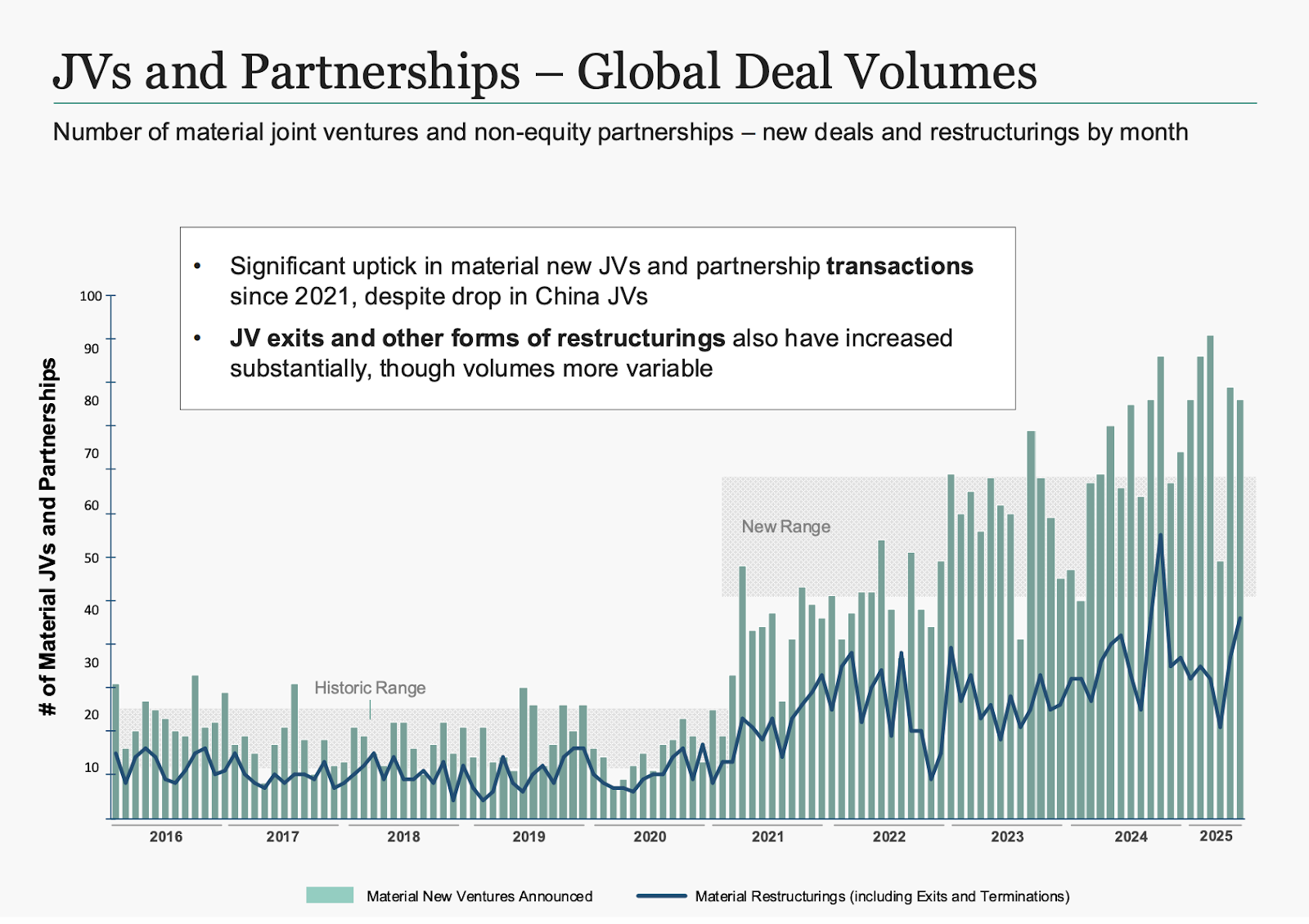
The numbers tell a compelling story: joint ventures have become the fastest growing business relationship structure globally.
The Rising Tide of Joint Ventures
Joint ventures are experiencing explosive growth. Since 2021, we're seeing 90 to 100 material joint ventures announced monthly, each worth at least $250 million. That's triple the volume from just five years ago.
Why Companies Can't Avoid Joint Ventures
Companies don't enter joint ventures because they are easy. They feel compelled by necessity:
- Access to Capabilities: Companies need complementary products, services, or technology they can't develop alone
- Learning Opportunities: Japanese and Chinese companies have business cultures of using JVs to develop capabilities
- Scale and Synergies: Combining existing businesses creates immediate market presence
- Risk Management: When projects cost $20 billion, even the largest companies want partners
- Regulatory Requirements: Foreign investment rules often mandate local partnerships
Some sectors depend heavily on joint ventures. For example, James shared that a recent estimate points to large automotive companies generating 20% of earnings from JVs. In natural resources, the numbers are even more striking: 76% of the world's largest copper mines and 90% of upstream oil and gas production operate as joint ventures.
The Governance Challenge
The median joint venture lifespan is 10 years, up from seven years three decades ago. Natural resource ventures last longer due to license terms and development timelines. Tech and consumer goods ventures often wrap up much more quickly.
CalPERS, the massive US pension fund, puts it bluntly: "Joint venture governance is pound-for-pound more physical than corporate governance."
Here's why joint ventures create unique governance headaches:
Structural Differences from Public Companies
Ownership Structure
- Public companies: Thousands of individual and institutional investors
- Joint ventures: Two to four corporate shareholders
Board Composition
- Public companies: Mostly independent directors
- Joint ventures: 98% are shareholder executives wearing two hats
Management Relationships
- Public companies: CEOs report to boards
- Joint ventures: 40% of CEOs are seconded from shareholders, returning after 3-5 years
Director Tenure
- Public company boards: 8-year average tenure
- Joint venture boards: 3.5 years tenure (is this enough time to understand the business?)
The "Nobody Owns the Baby" Problem
Directors know they'll rotate out in two years. Their careers depend on their home company, not the venture. The result? Less ownership mentality and shorter-term thinking on behalf of the average director.
"Directors spend their first six months learning the business and their last six months knowing they're leaving. That leaves maybe two productive years."
Complex Relationship Dynamics
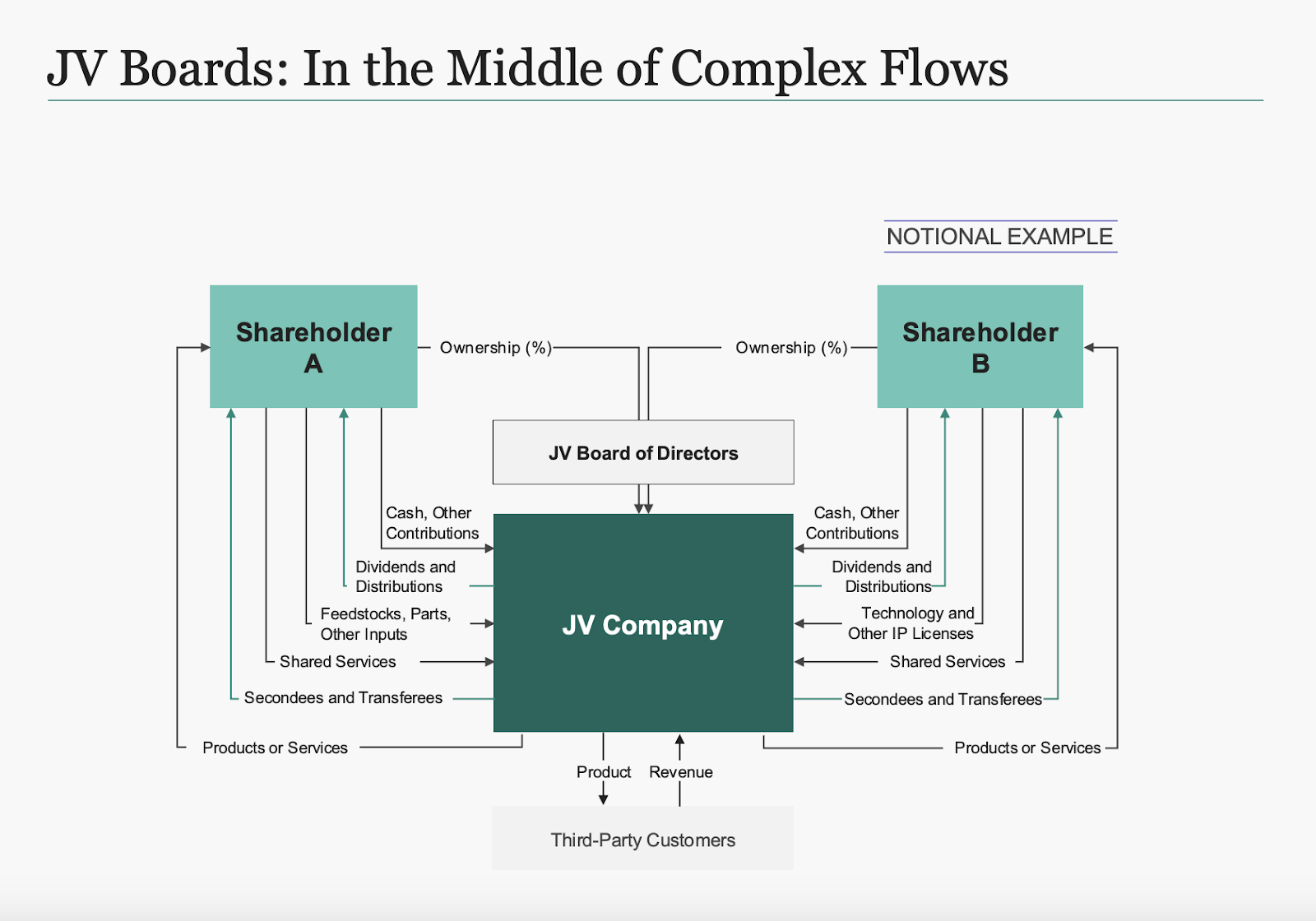
Joint ventures involve multiple flows between shareholders and the venture itself:
- Cash contributions and dividends
- Technology licensing
- Shared services and seconded employees
- Product sales between parties
- Feedstock and input supplies
These create constant conflicts: Are you optimizing for your shareholder's interests or the joint venture's success?
Time Drain on Management
Joint venture CEOs spend nearly 20% of their time on governance and shareholder management, compared to 8-10% for public company CEOs. This includes:
- Preparing for board meetings
- Managing shareholder information requests
- Helping shareholders secure internal approvals
- Navigating between competing shareholder interests
Governance Best Practices That Actually Work
Lead Directors Make a Difference
Each shareholder should designate a lead director who:
- Coordinates their company's board members
- Meets regularly with other lead directors
- Takes accountability for strategy and performance
- Commits at least 20 days annually
Keep Board Meetings Manageable
Joint venture boards typically have 6-10 directors. But meetings often balloon to 25 people when you add management teams, alternates, and observers. This creates presentation theater instead of real discussion.
Best practice: Limit non-directors to five people maximum.
Focus on Strategy and Talent
Boards that spend at least 20% of their time on strategy and growth significantly outperform those that don't. Yet talent issues, critical in ventures with high secondee turnover, often get minimal attention.
Consider Independent Voices
While only 10-15% of joint ventures have truly independent directors, adding a non-voting independent chair can provide crucial perspective. As one director noted: "They become the person both parents trust to tell them how the baby's really doing."
Annual Strategic Offsites Matter
Bringing together board members, management, and senior sponsors from shareholders for strategic discussions happens in only half of
joint ventures. Those that do it see better alignment and longer-term thinking.
The Cross Cultural and Localization Challenge
Joint ventures span globally and therefore face additional complexity around a myriad of requirements.
Cultural differences add another layer when partners come from different countries. Japanese partners may view boards differently than American companies, yet both perspectives must function within the same board. Local employment requirements in markets like Saudi Arabia and the UAE require careful talent development programs that take years to implement effectively. International partners initially rely on expatriate secondees but face pressure to develop local talent.
Some companies create communities of JV practitioners to share knowledge, though this remains uncommon. Middle Eastern national oil companies like Saudi Aramco and ADNOC have been particularly effective at bringing together their directors quarterly to discuss common issues. For the most material ventures, CEOs of parent companies may meet annually to address strategic challenges.
Success requires thinking long-term: recruiting locally, providing international training rotations, and building career paths so local executives can eventually run the venture.
Recent Joint Venture Activity Examples
Here are some new formations and major restructurings that James highlighted:
New Formations
- BHP-Lundin: Created a 50-50 joint venture named Vicuña for Argentinian copper projects worth billions
- Anglo American-Codelco: Formed a jointly owned operating company for two adjacent Chilean copper mines
- Eni-Petronas: Consolidated Malaysian and Indonesian upstream positions into a regional JV
- Intel-Apollo: Apollo invested $11 billion into a semiconductor fabrication venture in Ireland
Major Restructurings
- Rio Tinto-Turquoise Hill: Rio in 2022 bought out public shareholders to gain direct control of Mongolia's Oyu Tolgoi mine
- Clorox-P&G: Clorox is acquiring P&G's remaining stake in their 22-year venture (ending closing in 2026)
- BP-Equinor: An asset swap terminating their US offshore wind partnership with BP taking full ownership of the Beacon Wind projects, while Equinor taking full ownership of the Empire Wind projects.
Building Better Joint Venture Governance
Joint ventures will continue proliferating as companies seek capabilities, manage risks, and enter new markets.
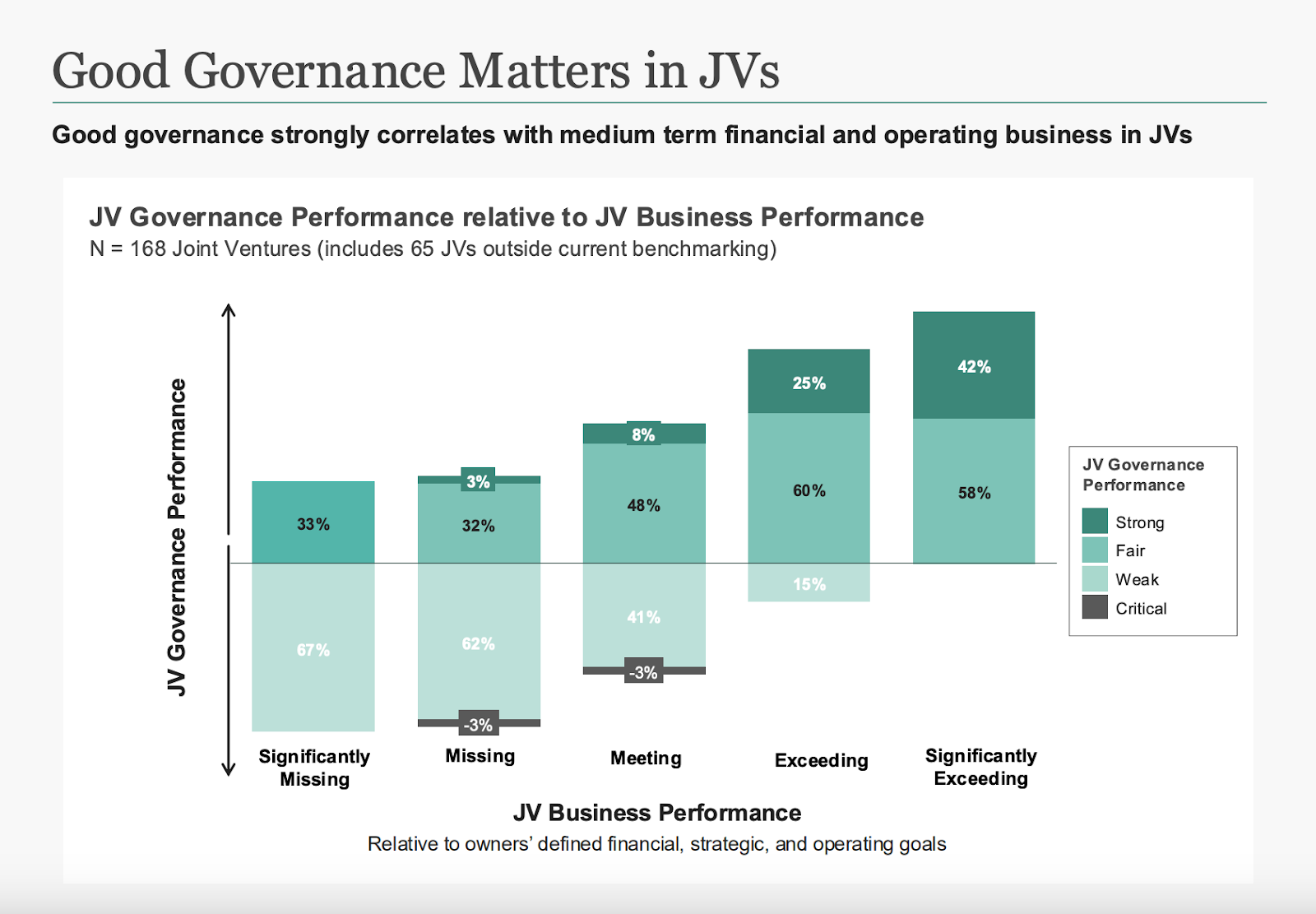
The correlation is clear: Joint ventures with strong governance are twice as likely to exceed their financial and operating targets. Those with weak governance overwhelmingly miss their goals. The governance challenges won't disappear, but companies that build strong governance muscles now will have significant advantages.
Several approaches can improve JV governance without compromising shareholder control. A non-voting independent chair can provide focus on collective interests without casting tie-breaking votes. This role helps prevent shareholders from overreaching into operations while keeping them aligned on strategy.
Companies should limit non-directors in board meetings and ensure all committees include actual board members to maintain connection with board priorities. Clear documentation about engagement before required approvals prevents confusion and overreach. Adequate staffing of governance functions and regular governance reviews help maintain effectiveness.
The rapid growth in joint ventures makes improving their governance critical for global business. While JV boards will always face unique challenges from their dual corporate ownership structure, companies that implement professional governance practices position their ventures for better performance. As one pension fund noted, joint venture governance is "pound for pound more difficult than corporate governance" yet equally important given ventures' materiality to many companies' earnings.
Key takeaways for boards:
- Invest in director continuity and engagement
- Create clear governance frameworks upfront
- Balance shareholder interests with venture success
- Plan for evolution as strategies diverge over time
The companies mastering joint venture governance today are building critical capabilities for tomorrow's increasingly collaborative business landscape.
Continue Your Learning
If you found the session’s insights valuable, there are several ways to go deeper.
Read The Compass Points of Good Governance, David Beatty’s new book on practical governance. It’s a concise reference guide for directors seeking to navigate complexity with confidence.
Finally, don’t miss the next edition of the Board Chair newsletter. Subscribe on David’s website to stay connected with the ideas, tools, and conversations shaping modern governance.